Distributed Cloud Bot Defense
Putting Bot Defense in front of a BIG-IP application
What the integration actually asks the BIG-IP to do, the ways to build it, and how to tell which one your customer needs — before you promise any of them.
Three components, wherever you deploy it
This part does not change between a Distributed Cloud deployment, a CDN deployment and a BIG-IP one. Only the third bullet on the middle box — who enforces — is what the rest of this deck is about.
Bot Defense, end to end
1 the enforcement point sends a protected request down for inspection · 2 what is allowed comes back, marked as already inspected. Those two arrows are the entire BIG-IP integration. Everything else on this slide is F5's side of it.
Zero trust, applied to the device
Worth being able to explain, because it is the first thing a security architect will push on: why not just read the headers?
Trust nothing the device claims
A User-Agent is a string an attacker sets. So are the rest of them. Self-declared identity is evidence of nothing.
No decision logic in the client
Anything shipped to the device can be read and rewritten. The client gathers; the engine decides.
Hundreds of signals per transaction
Gathered and transmitted securely, with sensitive values hashed before they leave.
Tamper and reverse-engineering detection
Checksums and integrity checks, so a modified client is itself a signal rather than a blind spot.
Every line of that is attacker-controlled. Which is the whole argument for putting a telemetry client on the page — and the reason one of the BIG-IP's three jobs is delivering it.
What that asks
of the BIG-IP
Strip away the implementation and there are three jobs. Two of them turn out not to need code at all.
Three jobs. That is the entire brief.
Send protected requests to the service
In reverse-proxy mode, Bot Defense is a service the BIG-IP steers traffic into. Login, checkout, whatever the policy protects — those requests go there first instead of straight to the application.
a routing decision
Put the telemetry script on the pages that need it
The pages where a user starts a session get a <script>
tag injected into the HTML. That is what collects the signals the
service scores.
content, not routing
Recognise the traffic coming back
Bot Defense inspects a request and hands it back to the same virtual server. The BIG-IP has to know this one has already been inspected and send it on to the application, instead of round-tripping it forever.
a routing decision
The round trip, on a whiteboard
This is the picture to draw when the customer's network team asks what changes. It is worth a minute — every design decision later comes back to the fact that the request leaves and returns on the same virtual server.
- 1Protected — send it for inspection. First leg. If the service is unreachable, straight to the application instead.
- 2It comes back, marked. Second leg. Same virtual server, carrying a header the engine added.
- 3Recognised — stop evaluating. The policy takes no action, so the request falls through to the default pool.
Two of the three jobs are routing.
Routing is what an LTM policy is for.
Jobs 1 and 3 — configuration
Which pool does this request go to? Asked once on the way out and once on the way back. That is the same object the customer's admins already use for host-based steering and URI rewrites.
It is a first-match policy with a handful of rules, and the paths it matches live in data groups — records in a list, not decisions buried in code.
Job 2 — a small iRule
Only putting the script on a page needs an iRule at all, and that piece never decides where traffic goes. It flags an entrypoint, turns the HTML profile on for that response, and gets out of the way.
Which is a very different kind of object to hand a customer than one that owns pool selection.
Three ways to
build it
All three are supported. All three work. They are not competing — they cover different amounts of ground, and picking the wrong one is expensive in opposite directions.
An LTM policy and a small iRule
For a web-only deployment where Bot Defense returns traffic to the virtual server directly — which is most of them — the same three jobs are configuration. Same traffic flow, same service, different objects.
The policy does the steering
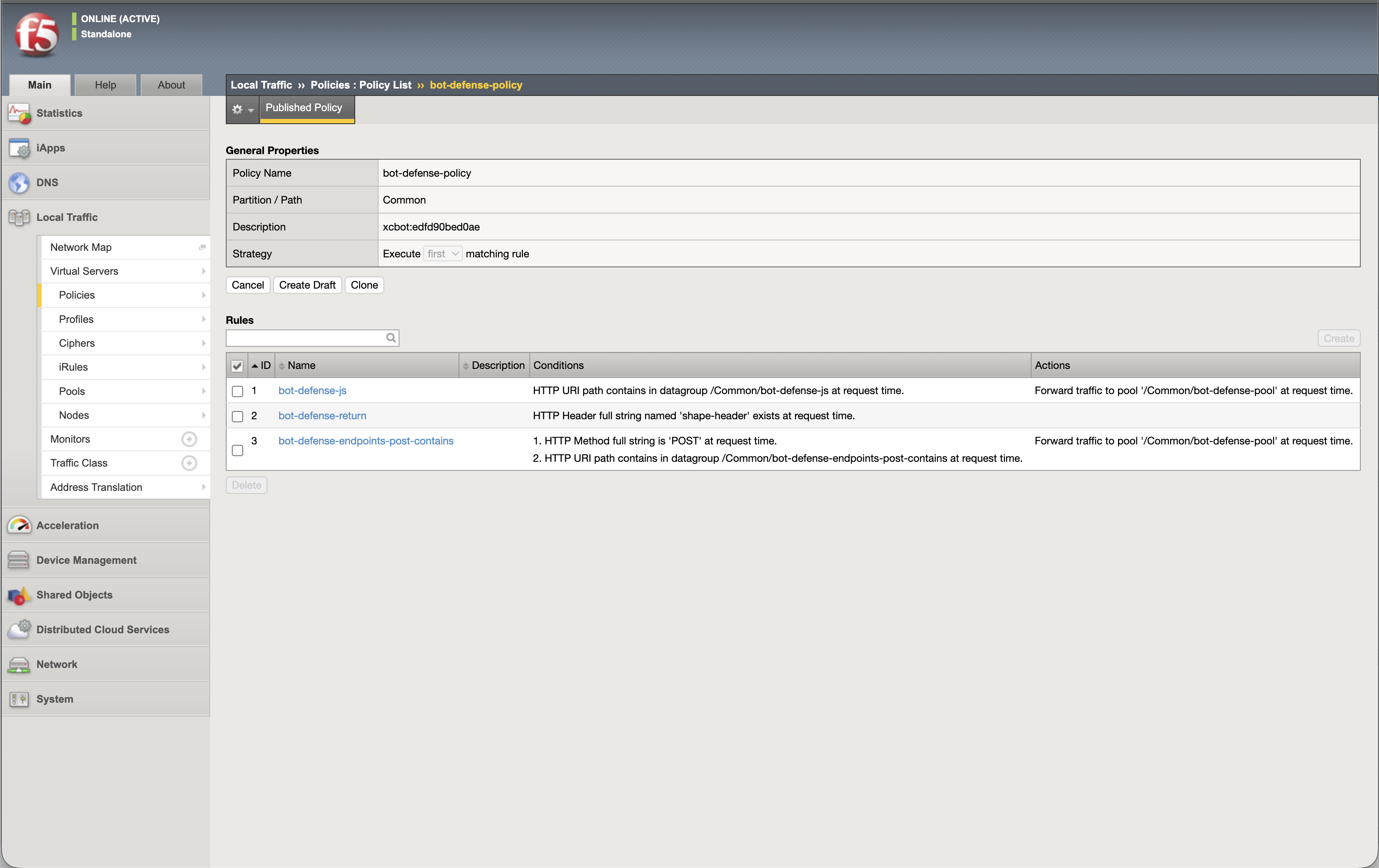
First match wins, so the order is the logic. Rule 1 is how already-inspected traffic is recognised; taking no action lets it fall through to the default pool.
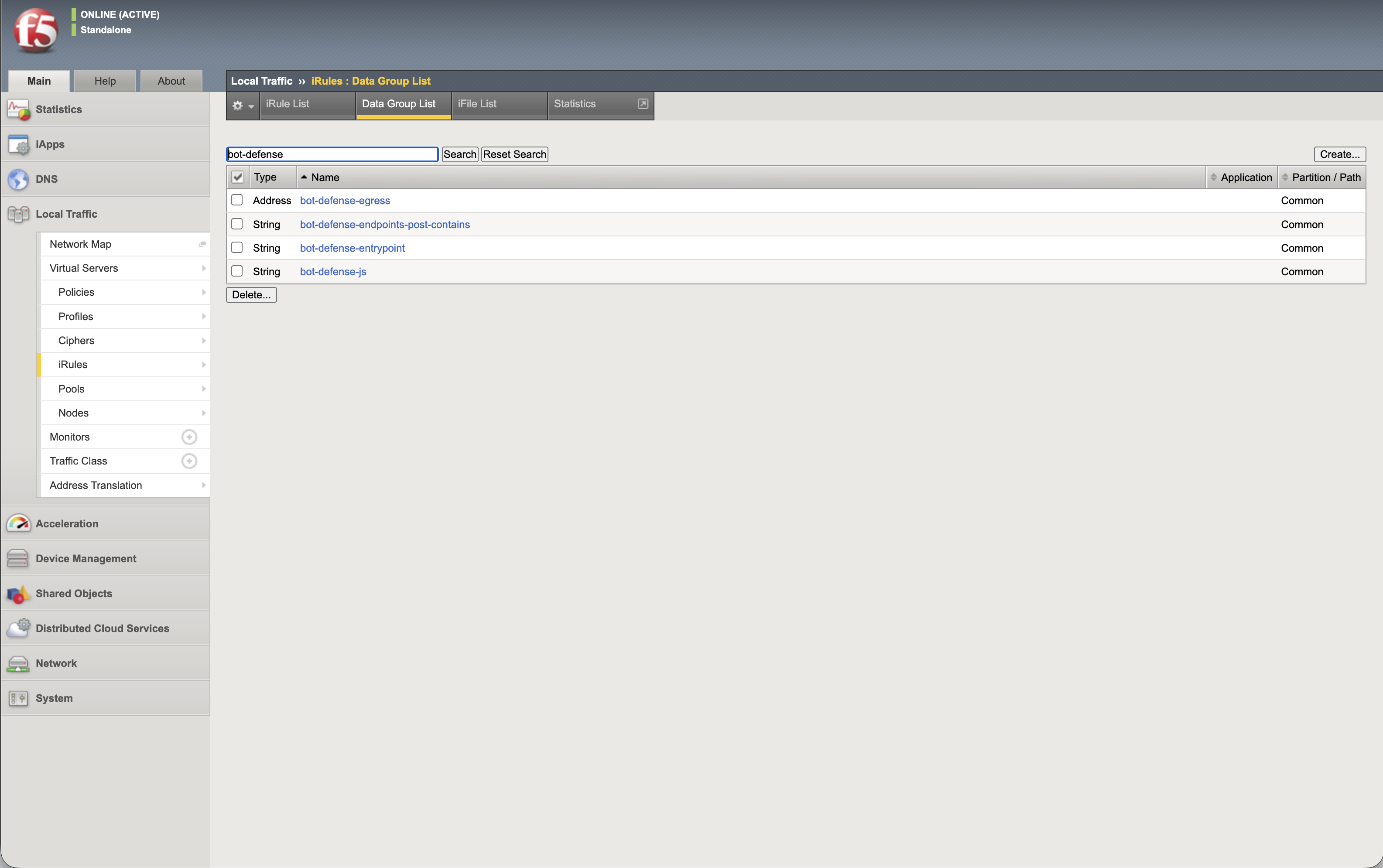
The paths live in data groups
One list per method-and-operator combination, filled from the endpoint list in the XC console. Adding a protected endpoint later is a record in a list — not a code change.
The iRule does the injection, and nothing else
Flags a request as an entrypoint, disables the HTML profile on every response that is not one, and turns off server-side SSL when the service leg is not on 443.
It never selects a pool. That is the property that makes it safe to hand over — it cannot silently override the policy, because it has no opinion about where traffic goes.
Plus the ordinary furniture
A pool and health monitor for the Bot Defense service, an HTML
profile carrying the <script> tag, and a
OneConnect profile. Objects a BIG-IP admin creates every week.
The F5 iRule
F5-authored, F5-maintained, and the reference implementation. It is a pair of iRules — a configuration rule you edit and a base rule you do not — and it is the right answer whenever the deployment needs any of the things below.
Mobile SDK traffic
Mobile endpoints as well as web, handled by header rather than path.
Interstitial mode
The challenge-page flow, end to end.
SNAT on the service leg
Evaluates SNAT per connection and can restore the real client address.
Persistence
Inserts its own cookie so application persistence cannot override the pool it picked.
True-client-IP
Inserts the client address on the way out and strips it on the way back.
Several apps, one VS
Multiple applications with different policies behind a single virtual server.
Double-evaluation control
Turns ASM and Bot Defense off on the second leg so nothing is scored twice.
Graceful degradation
Answers the telemetry script itself when the service pool is down, so the page still loads.
The iApp connector — API Mode
What the customer inherits
- four rules, readable as a table in the Configuration utility
- the order is the logic, and it is on screen
- the protected paths, one list per method and operator
- the service's egress addresses
- the telemetry script path
- request: is this an entrypoint?
- server connected: server-side SSL off when the leg is not 443
- response: HTML profile off, on again if flagged
- does not steer
- carries the
<script>tag itself
- the virtual server's own name, set by hand
- pool name and three data-group names
- telemetry header prefix from the console
- SNAT command · persistence command
- true-client-IP header and layer
- debug level · web / mobile / interstitial
- must exist, must not be attached to the VS
- connection setup: ID, SNAT and persistence evaluation, app selection
- request: client-IP extraction, web/mobile detection, second-leg detection, entrypoint and endpoint flagging, spoofed-header stripping
- request again, later: pool, SNAT, persistence, XFF
- response: HTML on/off, interstitial handling
You are not meant to read either column. That is the point — one of them, somebody has to. The question is not which is shorter; it is which one the customer's admin can still explain after you have left.
What Option A does not do
The F5 iRule exists because these cases exist. If the deployment needs any one of them, that is the answer — and saying so early is cheaper than discovering it in a change window.
| Case | Where Option A stops |
|---|---|
| SNAT on the service leg | The design recognises returned traffic by its source address. A SNAT in between breaks that. The F5 iRule evaluates SNAT per connection and can restore the client IP. |
| True-client-IP header | The F5 iRule inserts a configurable client-address header outbound and strips it inbound. Option A does not need to — it preserves the client address instead — but it also cannot provide the header. |
| Persistence | The F5 iRule inserts its own cookie so application persistence cannot override its pool selection. |
| Mobile SDK traffic | Not covered. Mobile endpoints are reported and skipped. |
| Interstitial mode | Not covered. |
| Double evaluation | The F5 iRule disables ASM and Bot Defense on the second leg. Option A does not. |
| Script when the pool is down | The F5 iRule answers 200 with no-cache so the page still loads. Option A's script rule has no fallback pool. |
path_and / path_none | No single-rule policy equivalent. Reported and skipped, by name. |
| An existing pool-selecting iRule | It silently wins over the policy for the requests it touches. Use Option B. |
Four questions that decide it
Ask all four before you commit to an approach. Any yes and Option A is the wrong tool — bring an engineer, and say so on the call rather than in the change window.
Configuring it
What the network looks like, what you create, and what the screens actually say. From here on it is the build.
Where everything sits
Two addresses do all the work. You send to the service by name, and you recognise what comes back by the address it came from — which is why a SNAT anywhere on that return leg breaks the design. Trace that path before you commit to the approach — it is the one limit you cannot see from the BIG-IP configuration.
Six objects, and two you check first
/Common/http and a plain OneConnect are
fine.
Pool + health monitor
One pool for the Bot Defense service, member by FQDN on 443, with a monitor so the box knows when it is unreachable.
Data groups
The protected paths — one list per method and match operator — plus the service's egress addresses and the telemetry script path.
LTM policy
First match. One rule for the script path, one that recognises returned traffic, and one per method-and-operator pair.
iRule
Entrypoint flag, HTML profile on and off, server-side SSL off when the service leg is not 443. No pool selection.
HTML profile + rule
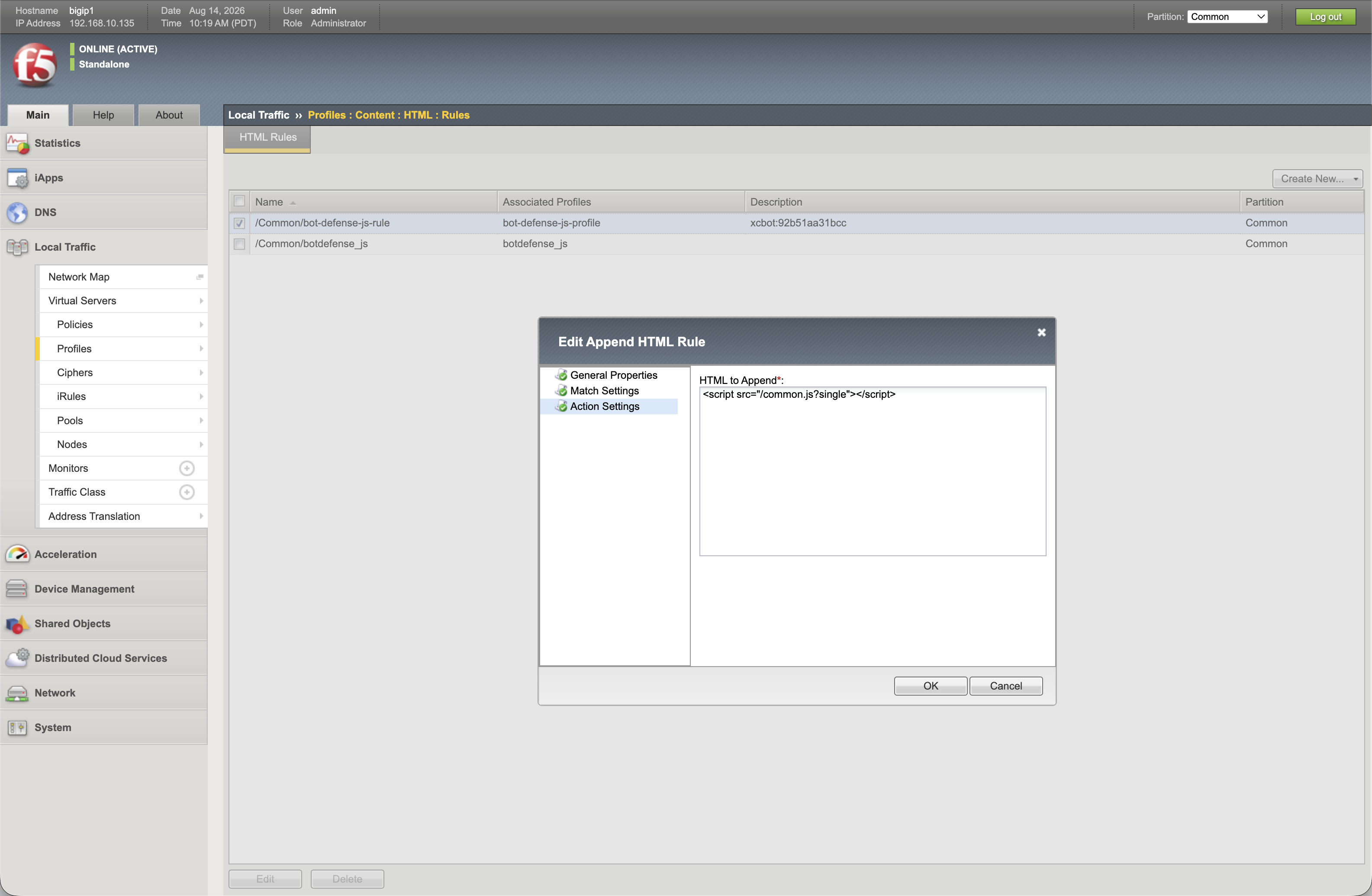
Appends the <script> tag to the head of entrypoint
responses. This is the only object that edits the page.
The attachment
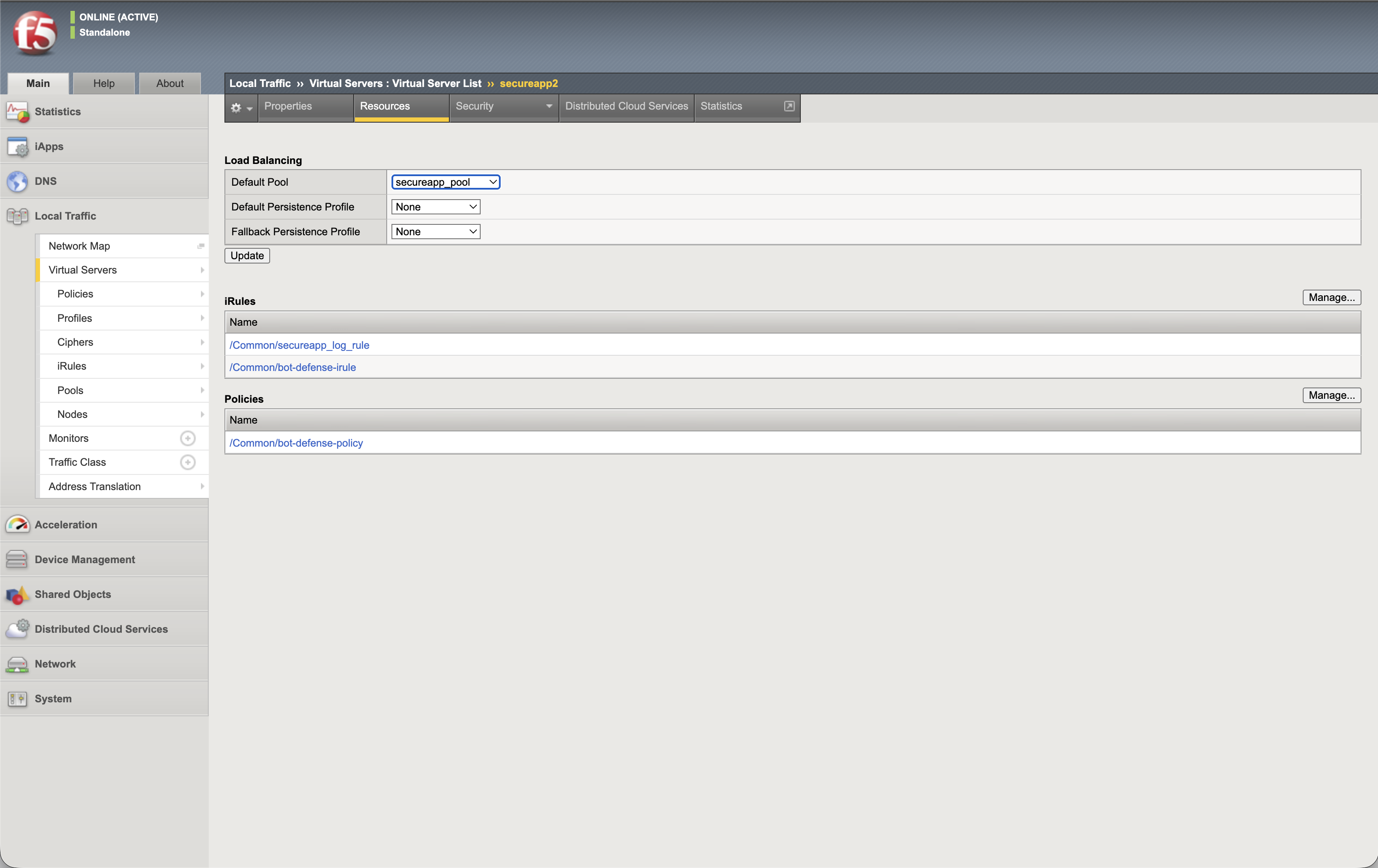
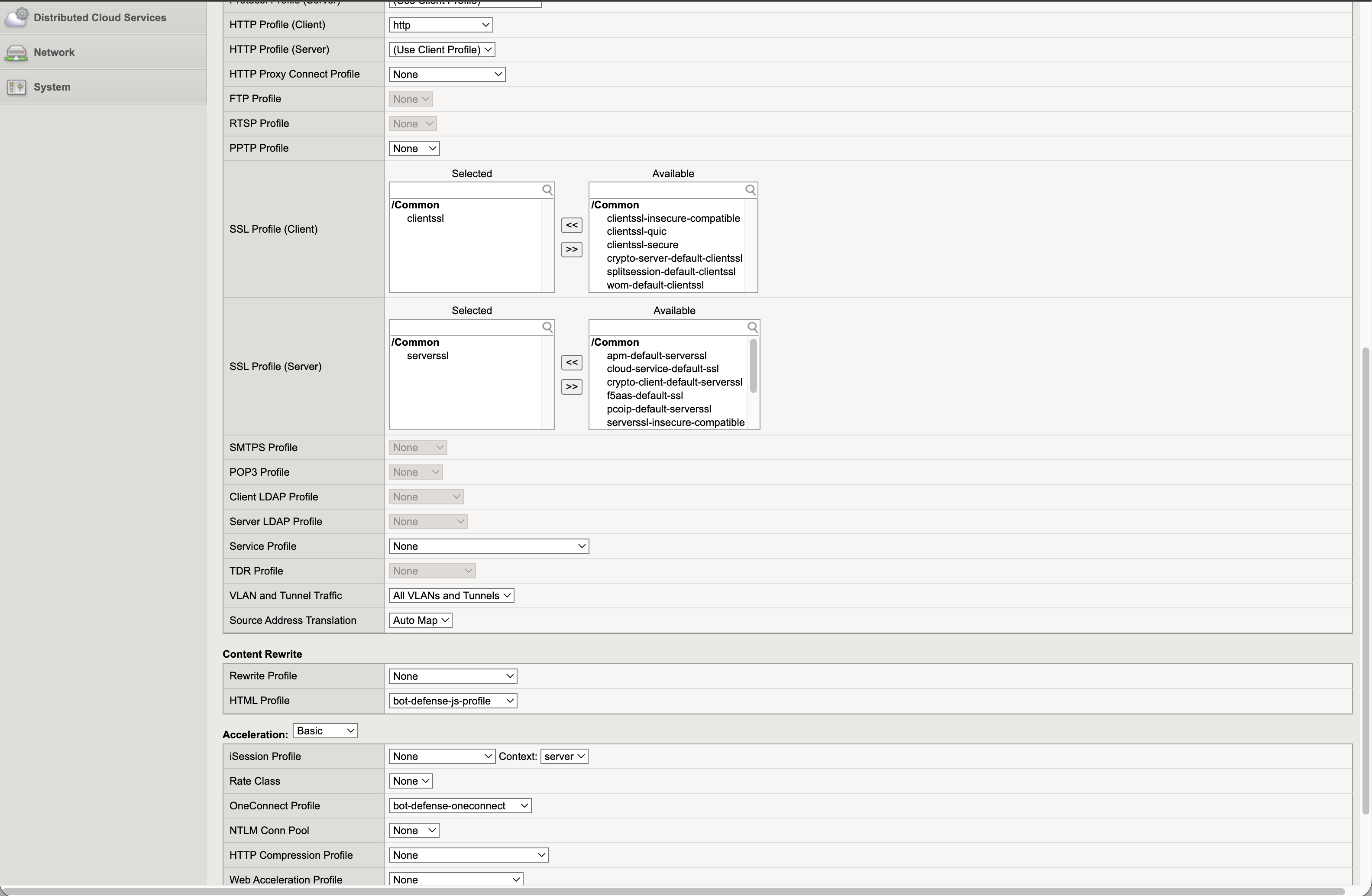
Policy, iRule, HTML profile and OneConnect on the virtual server. The one step that touches production — and the one you undo first.
The whole decision, on one screen
- A
Execute first matching rule The order is the logic. Read top to bottom and you have read the deployment.
- B
The script path, first The telemetry request goes to the service before anything else can claim it.
- C
Then the rule with no action
shape-headerexists and the source address is in the egress list. Both halves are required — the header alone is client-settable. Matching, the rule does nothing, and the request falls through to the application. - D
Then the protected endpoints One rule per method and match operator, each reading its paths from a data group.
A CDN in front of the BIG-IP does not break this. Client traffic arriving
with the real address in X-Forwarded-For is fine —
rule C is about the return leg, and that leg comes straight from
the service. If it cannot, the fix is on the XC side, not here.
Where the paths live, and where the tag comes from
Attaching it — and undoing it
Everything so far was new objects, invisible to traffic. These two tabs are the change, and they are also the rollback: detach, and the virtual server is exactly what it was.
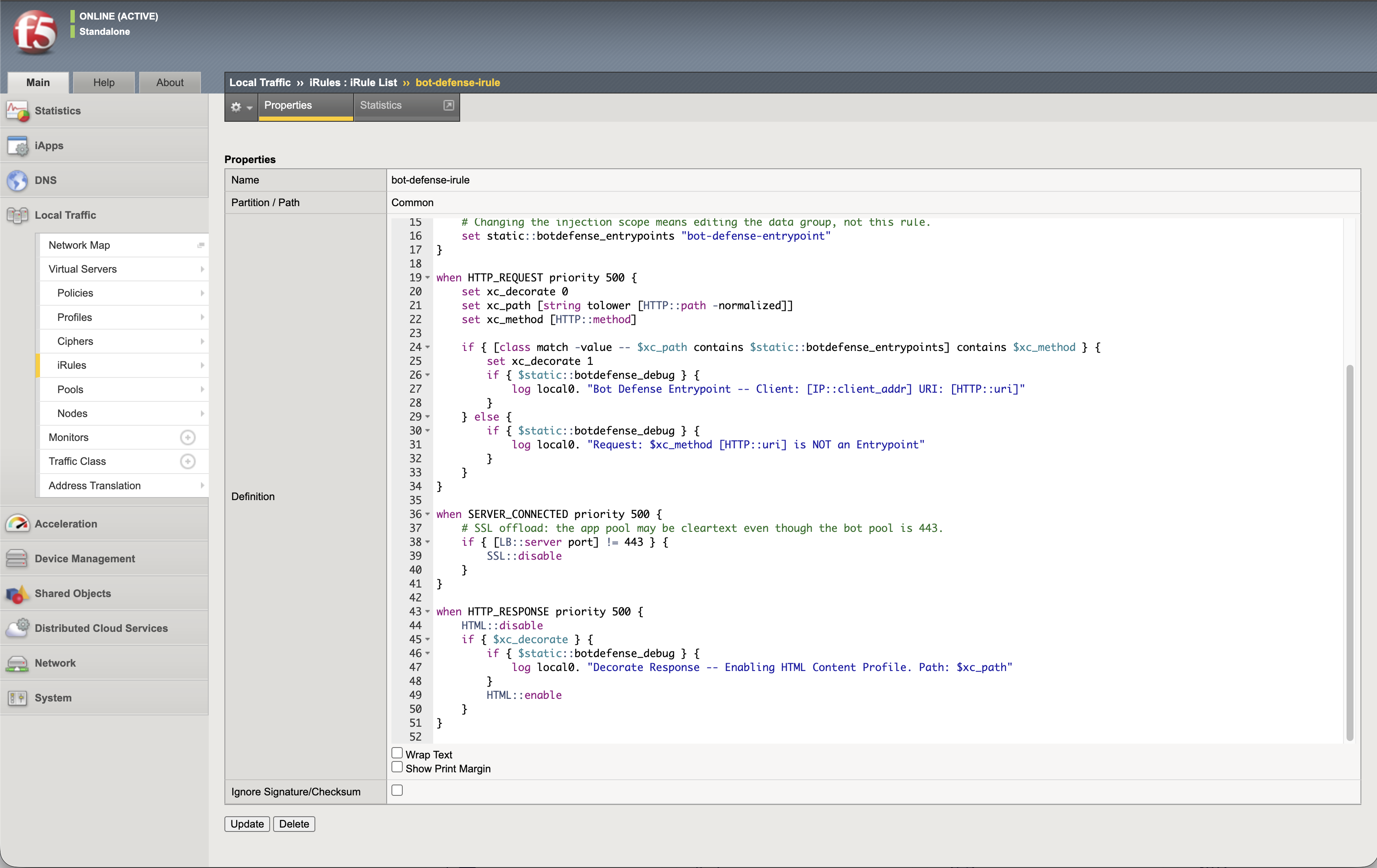
What the 33 lines actually are
Worth opening once, on your own, before you present. It is short
enough to read in a change window, and the thing to notice is what is
not in it: no pool command, no
snat, no persistence, no conditional steering. It flags
an entrypoint, turns the HTML profile off and back on, and drops
server-side SSL when the service leg is not 443.
Six months later
What you deploy is a snapshot
The protected endpoint list in the XC console is owned by the security team, and it moves. A new login flow ships, a path is renamed, an API version is added — and the BIG-IP does not know.
This is true of both options. The difference is what the fix costs.
With Option A the fix is a record
A new protected path is a record in a data group. Somebody who has never seen the deployment can add it, in the Configuration utility, without reading a line of TCL and without a code review.
Optional: keep it in step automatically
If the customer would rather not do that by hand, the toolset that accompanies this deck reads the endpoint list from the XC API and writes the same objects — and, more usefully, tells you when the box has drifted from the console.
It is a convenience, not the method. Nothing on the previous six slides depends on it — if the customer never runs it, the deployment is still complete and still explainable.